Sydney Harbour, April 2025
The Australian Robotics Inspection Asset Management (ARIAM) Hub is partnering with the Sea Heritage Foundation on an innovative hull repair project for the historic former lighthouse tender MV Cape Don, combining advanced AI robotics with traditional maritime engineering.
The project marks a significant step in the preservation of Australia’s maritime heritage while also contributing to national innovation in naval inspection and repair technologies. Following the successful decontamination and removal of hydrocarbons from the vessel, work has now commenced on assessing and planning critical external repairs along the ship’s wind and water line.
While the MV Cape Don remains structurally sound internally due to earlier restoration works overseen by Thales and naval architects at the Garden Island Dry Dock, the long-term preservation of the vessel depends on addressing wear and degradation to the outer hull. These repairs are crucial in securing the ship’s future as a living maritime museum and training platform.
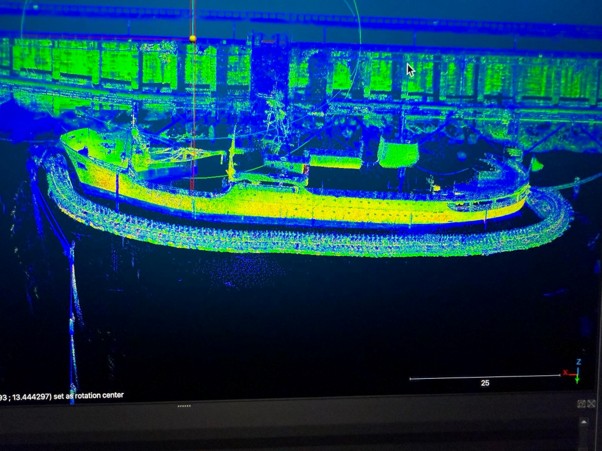
To support this work, ARIAM Hub researchers, in collaboration with experts from Queensland University of Technology (QUT), have deployed advanced drone‑based scanning and mapping technologies to undertake a detailed digital survey of the vessel. Using high‑resolution sensors, the team captured precise 3D scans of the external hull and selected internal compartments.
The scans aid in creating digital models which will form the foundation for engineers and naval architects to develop a comprehensive, fit for purpose scope of works. Specialist contractors will then use this data to design and implement targeted repair solutions, ensuring accuracy, safety, and efficiency throughout the restoration process.
The project reflects a best‑practice approach to asset inspection and management, emphasising expert consultation, rigorous safety standards, and transparent collaboration with local and state government authorities. Importantly, the data generated through ARIAM’s work will also contribute to ongoing national research efforts, supporting future advancements in naval ship battle damage assessment and repair technologies.
Sea Heritage Foundation Chairman Dr CJ Manjarres‑Wahlberg said the project demonstrated the powerful intersection of heritage preservation and modern technology.
“This project is an extraordinary example of how a heritage preservation project and modern technology can come together to create lasting benefits,” Dr Manjarres‑Wahlberg said. “It’s 1960s technology and state‑of‑the‑art AI working hand in hand. We are not just restoring a ship; we are actively contributing to helping future‑proof Royal Australian Navy vessels through the work we are involved in.”
Thanks for the ongoing support of North Sydney Council, the ARIAM Hub, NSW Maritime, the Port Authority of NSW, Thales Australia, and Gibson Minto in enabling this project.
We are pleased to support a project that demonstrates how heritage preservation and modern AI robotics can work hand in hand to deliver lasting impact.