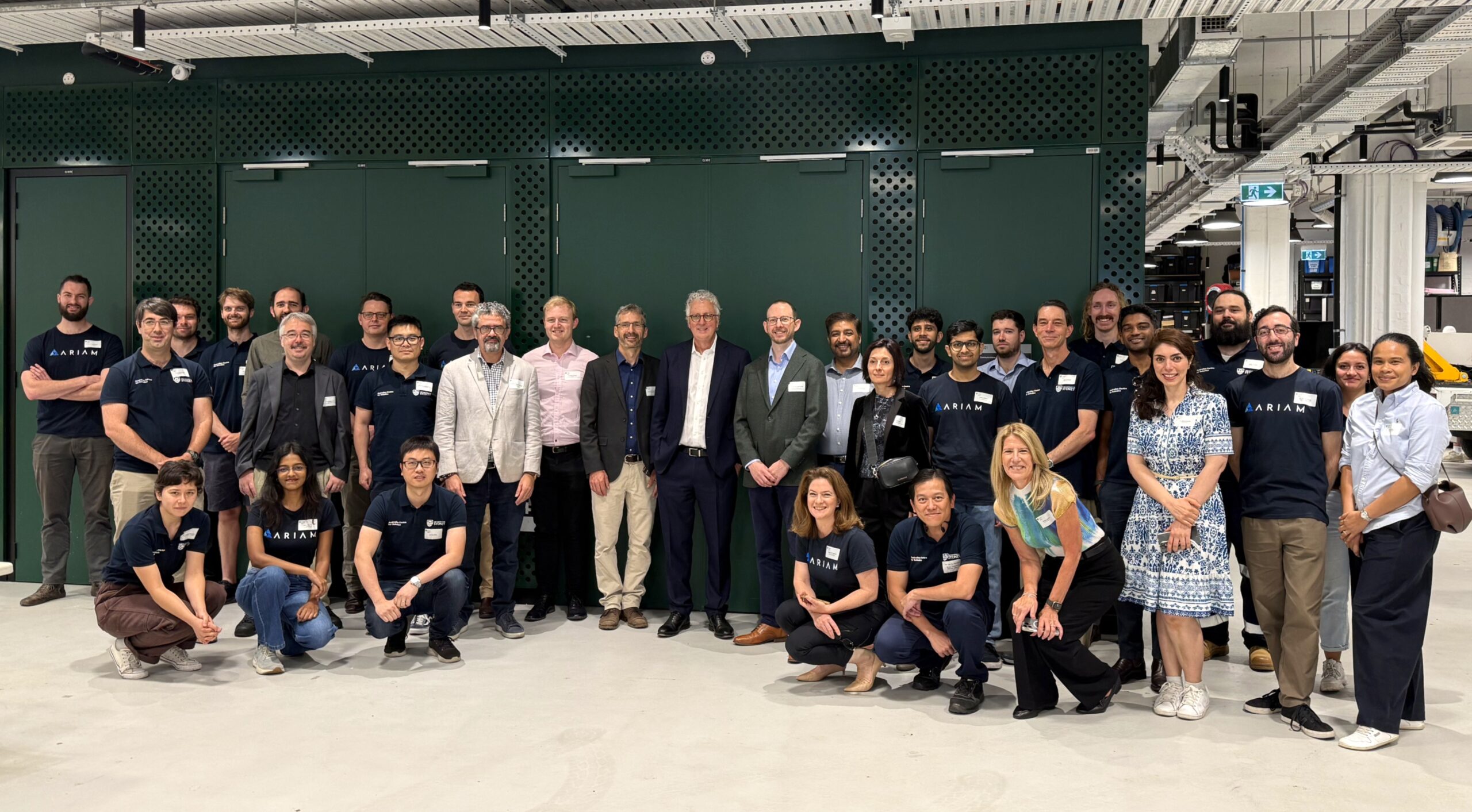
On Friday 15 October, researchers from ARIAM had the opportunity to visit our partner, Australian Nuclear Science and Technology Organisation (ANSTO), for a guided tour by the ANSTO Discovery Centre.
The visit offered an in depth look into the world of nuclear science and the diverse work ANSTO undertakes across various sectors such as health, environmental research, and industry solutions.
Highlights included a tour of the OPAL reactor, Australia’s only active nuclear reactor, operated by ANSTO, which is used to irradiate samples of medical and industrial applications such as semiconductor manufacturing.
The team was also introduced to the Neutron Image Centre by Prof. Anna Paradowska, who shared details of her work in this area and insight into future developments in the field. The Molybdenum-99 manufacturing facilities, which provides radioisotope generators to more than 250 hospitals around Australia and New Zealand, was next in the tour. The team gained valuable insight into how nuclear medicine is handled and how robotics could be utilised in the future, given the challenges involved in the field. Several members of the ANSTO nuclear medicine team also discussed their work, organisation’s history, and how ANSTO is incorporating automation and robotics to improve safety and productivity in their nuclear medicine manufacturing.
The ARIAM team also visited ANSTO’s Australian Synchrotron facilities, which operate particle accelerators to study fundamental physics, along with studying real world applications like the effect of radiation on electronics within the satellites and instruments in space. Here, the team was able to get up close to the accelerator itself and follow the life cycle of a particle in the accelerator.
After a morning packed with knowledge sharing, the visit concluded at the ANSTO cafe for lunch. Whilst the tour was informative, according to one ARIAM researcher the “full-sized beef enchilada for $9 in this economy was enough to be a memorable experience in itself”.
We thank the ANSTO team for welcoming us and offering our researchers the opportunity to explore their world class facilities and gain insight into the work and research conducted at ANSTO.